If You’re Planning to Watch This, Read This First
When BTS holds a large-scale public event in Seoul, it’s not just a concert — it affects the entire city.
From crowd control to transportation changes, even people who are not attending can feel the impact.
If you’re planning to watch it, especially as a foreigner, there are a few things you should know in advance.
1. Basic Information About the BTS Gwanghwamun Concert
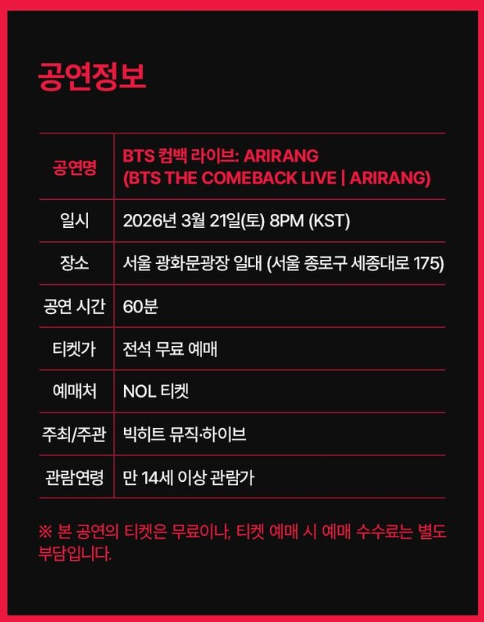
This event took place near Gwanghwamun Square, one of the most central and symbolic areas in Seoul.
Key points:
- location: Gwanghwamun / central Seoul
- format: large public outdoor event
- audience: both ticket holders and general public
Unlike typical concerts, this type of event is designed to be partly open and accessible, which is why it attracts such large crowds.
2. Why This Concert Was Different
This wasn’t just another K-pop performance.
Several things made it stand out:
- it was held in a major public space
- access was partially open to the public
- the scale was closer to a city event than a concert
Because of this, the experience felt more like a festival or national celebration rather than a ticketed show.
3. How People Watched Without Tickets
One of the most interesting parts of this event was that many people were able to watch it without official tickets.
Here’s how it actually worked:
Public viewing areas
Large outdoor screens were set up in nearby areas.
This allowed people without tickets to still watch the performance.
Nearby streets and open spaces
Some people gathered in surrounding areas where the stage or screens were partially visible.
However, visibility varied a lot depending on where you stood.
Important reality check
If you didn’t arrive early, your view was likely:
- very far away
- partially blocked
- or limited to screens only
4. Traffic Control (What Actually Happens)
This is one of the most important things to understand.
During large events like this, traffic control is significant.
Road restrictions
- certain roads are closed or restricted
- taxis may not be able to enter the area
Bus route changes
- some bus stops are skipped
- routes may be temporarily changed
Subway congestion
Subways are still the best option, but:
- stations become extremely crowded
- entry/exit can take much longer
What foreigners often find difficult
If you don’t understand Korean announcements, navigating these changes can be confusing.
5. Before You Go: 4 Practical Tips
These tips make a huge difference.
1. Arrive earlier than you think
For popular events, even arriving 1–2 hours early may not be enough.
2. Choose your exit strategy
Leaving can be harder than arriving.
Plan where you will go after the event.
3. Bring essentials
- water
- portable charger
- comfortable shoes
You may be standing for a long time.
4. Don’t expect a perfect view
Unless you are very close, most people rely on screens.
6. Watching On-Site vs Watching at Home
Here’s a simple comparison.
On-Site Experience
Pros:
- real atmosphere
- crowd energy
- once-in-a-lifetime feeling
Cons:
- heavy crowds
- long waiting time
- transportation issues
Watching at Home (Streaming / Netflix)
Pros:
- clear video and sound
- no stress
- comfortable environment
Cons:
- no live atmosphere
- less emotional impact
7. One Thing Many People Don’t Expect
Even if you don’t attend the event, the area can still affect your plans.
If you’re staying near:
- Gwanghwamun
- City Hall
- Jongno
you may experience:
- delays
- crowded streets
- transport changes
Final Thoughts
The BTS Gwanghwamun concert was more than just a performance.
It was a large-scale public event that changed the flow of the entire area.
For some, being there in person was unforgettable.
For others, watching from home was simply more practical.
If you understand what to expect in advance, you can choose the experience that fits you best.